


One of Our Dear Friends — Puzdro Store
We’d love to share the story of one of our valued clients and dear friends, Ms. Ada Pfeifer of Puzdro Store in Warsaw.
We heard about Ada’s first encounter with furoshiki and the wonderful feedback from her customers.
Although Warsaw is far from Japan, furoshiki has created a special connection between us, bringing together people who love Japanese culture, thoughtful design, and more sustainable living.
We were also delighted to visit Puzdro Store in 2025 and celebrate Christmas together. We created a quiet and elegant Christmas display, met many wonderful people, and hosted a furoshiki workshop together.

The workshop was held at Klub Sztuk, a creative space run by two of Ada’s artist friends, where we had the wonderful opportunity to share the beauty and possibilities of furoshiki with the local community.
We sincerely thank Ada for welcoming us so warmly and creating such a comfortable and inspiring space.
This is the story of how one encounter in Japan grew into a wonderful journey in Warsaw.

Although furoshiki is at the heart of Puzdro Store, it is much more than a shop selling furoshiki.
Ada carefully selects each item based on its quality, story, history, and how well it fits the atmosphere of the store, rather than simply adding more products.

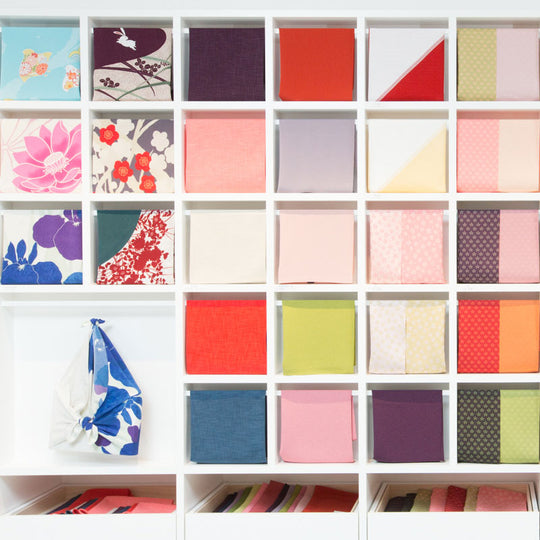
At Puzdro Store, visitors can see different ways to use furoshiki, learn how to tie it, and discover how it can become a bag, scarf, or beautiful gift wrapping. Ada also encourages people to give old fabrics a new life by using them in a similar way.
Alongside furoshiki, the store also offers carefully selected Japanese stationery, origami-related items, kokeshi dolls, folding fans, vintage-style glassware, and other unique objects.
In this way, Puzdro Store is not simply a place to buy Japanese products. It is a small space for discovering new ideas, ways of living, and sources of inspiration.


Ada’s Interview

1. How Ada Discovered MUSUBI Furoshiki
My whole adventure with furoshiki began when I saw your camellia furoshiki from the Yumeji Takehisa collection, a piece I still own and use to this day. It had been transformed into a strawberry-shaped bag and displayed in a shop window in Kappabashi. At first, I thought it was simply a bag, until the shop owner explained that it was a furoshiki and showed me a basic way to tie it.
During that same trip, I visited your store in Kyoto and was completely captivated by the sheer variety of patterns. What impressed me most was the quality of the craftsmanship. After almost three years of running my own shop, I know from experience just how exceptional the quality of MUSUBI's furoshiki really is.
When I decided to open my store, I had no doubt about who I wanted to work with. I knew from the very beginning that it had to be MUSUBI. It was your camellia design that first sparked my fascination with the art of furoshiki.
2. About Yamada Sen-i
I'm truly grateful that you believed in my vision from the very beginning. At the time, my store was still under renovation and I didn't even have a website yet. Still, you trusted my project.
Working with you has been completely smooth. Beyond the business relationship, there is a genuine sense of support and encouragement. Whenever I reach out with a request, you're flexible and always willing to help.
I was also very happy to have the opportunity to meet Mr. Yamada in person. I first discovered MUSUBI through its products, so it was very special to meet the person behind the company and hear more about its history and philosophy.
I was especially impressed by how much thought goes into the design of each furoshiki. What fascinates me most is how a pattern can reveal something completely unexpected once the furoshiki is folded or tied. Suddenly, you see a completely different part of the design, and this is when you can really appreciate the craftsmanship and thought behind it.
3. The Joy of Welcoming Returning Customers
Polish customers are, in most cases, curious and open to products that are new to them. They often ask about the production process, what the patterns mean, and who designed them. They're also eager to learn about the different ways a furoshiki can be used. One of the things that makes me happiest is seeing customers come back, or hearing that they received a furoshiki from my store as a gift and now want to give one to someone else. Among them, there are those who have fallen in love with furoshiki just as deeply as I have.
My store brings together many beautiful items from Japan, including retro glassware, paper goods, fans and other Japanese zakka. Furoshiki are the true heart of the store. They're what give the store its atmosphere and character. They also become part of the shop's interior, displayed in different sizes and tying styles alongside the other products.
I also use my Instagram to show different ways of using furoshiki and to share the stories, techniques and context behind them.

Ada’s dream is simple but meaningful: to keep her store going for as long as possible, and to travel around Poland to share the idea of furoshiki with more people.
She is not looking to scale her business simply for the sake of growth. Instead, she wants to meet people, introduce them to furoshiki, and show them how this simple piece of cloth can bring new possibilities into everyday life.
Her dream strongly resonates with our own vision at MUSUBI.
We believe that furoshiki is not just a product, but a way of connecting people, cultures, and ideas.
We are truly grateful to have Ada as a friend and partner, and we look forward to continuing this journey together — from Japan to Poland and beyond.